Frederic Anderson Luxembourg, b. 1973
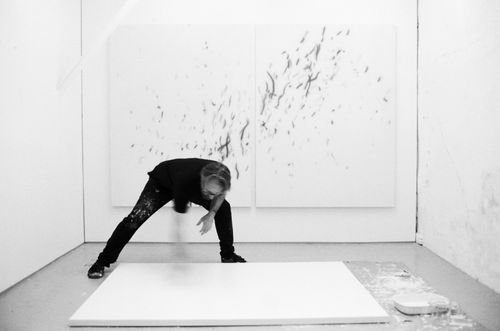
Frederic Anderson(b.1973, Luxembourg) was educated at the University of the Arts London and began with figurative drawing, later evolving his own abstract approach. He has held solo exhibitions in New York, Madrid, and Barcelona, received the Metro Imaging Mentorship and Made in Arts London awards, and was a finalist for the Tiffany & Co. Studiomakers Prize.
Frederic’s work always begins with drawing. For him, drawing is not just a preparatory step but a raw, intuitive process — a site of emotion and rhythm. Like music, his drawings emerge as immediate reactions, often completed within seconds or minutes. Only a few are later selected and developed into paintings through a long, considered process.
Once the drawing transitions into painting, the pace slows dramatically. Andersen aims to retain the tension and energy of the original, carefully controlling every element. Using airbrush — which keeps his hand off the canvas — he relies solely on sight and sensation to maintain balance. A single change in line thickness or density can shift the entire work, requiring intense focus — unlike the spontaneous nature of drawing.
Titles hold no fixed meaning. Like the drawings, they arise from intuition — spontaneous words or phrases that have no narrative tie to the image. He often juxtaposes words or combines lingering emotional tones, leaving space for viewers’ interpretations.
This conceptual openness is vital to his work. Andersen believes the empty space in painting can be central, even essential. He relates this to the Buddhist idea of emptiness (śūnyatā) — a space where traces emerge, disappear, and transform. These quiet voids are not blank, but dynamic fields of energy. For him, “nothingness is the sum of all potential,” pointing to abstraction’s philosophical depth.
프레데릭 앤더슨(b.1973, 룩셈부르크)은 런던을 기반으로 활동하는 회화 작가다. 초기에는 구상 드로잉에 몰두했지만, 이를 해체하고 재구성하며 자신만의 추상 언어를 발전시켜왔다. 런던 예술대학교에서 석사 과정을 마쳤으며, 뉴욕, 마드리드, 바르셀로나 등에서 개인전을 열었다. 메트로 이미징 멘토십 어워드와 메이드 인 아츠 런던 어워드를 수상했고, 티파니앤코 스튜디오메이커스 프라이즈 최종 후보에 오른 바 있다.
프레데릭의 작업은 항상 드로잉에서 시작된다. 작가에게 드로잉은 단지 준비 과정이나 밑그림이 아니라, 감정과 직관, 리듬을 가장 순수하게 담아내는 지점이자 실험의 현장이다. 그는 드로잉을 마치 음악처럼, 생각 이전의 반응으로 그려내며 빠르면 30초, 길어도 몇 분 이내에 완성한다. 그러나 그중 회화로 이어질 수 있는 것은 극소수에 불과하며, 오랜 시간을 거쳐 선별해 캔버스 작업으로 발전시킨다.
완성된 드로잉은 페인팅으로 이어지며, 이때부터 작업의 리듬은 급격히 느려진다. 그는 드로잉의 긴장과 에너지를 그대로 옮겨 담기 위해 회화 제작 과정에서도 미세한 구성을 유지하고자 노력한다. 특히 에어브러시 작업은 캔버스와 손이 직접 접촉하지 않기 때문에 선과 선 사이의 관계, 흔적들의 균형을 오롯이 눈과 감각에 의존해 조정한다. 선 하나의 굵기나 밀도가 달라지면 전체 균형이 무너질 수 있기에, 즉흥적으로 작업된 드로잉과는 반대로 극도의 집중력을 필요로 하는 과정이다.
작가는 작업의 제목에도 고정된 의미를 부여하지 않는다. 드로잉과 마찬가지로 제목 역시 즉흥적이고 감각적으로 떠오른 단어나 문장을 기반으로 형성되며, 작품 이미지와 직접적인 서사적 관계는 없다. 그는 하나의 단어를 바탕으로 연상된 또 다른 단어들을 병치하거나 감정의 잔향을 포착한 어휘들을 결합하는 방식으로 제목을 생성한다. 이러한 방식은 구체적 해석을 피하고, 오히려 관람자의 사고가 자유롭게 흐를 수 있는 개념적 여백을 마련한다.
이러한 여백은 그의 작업에서 매우 중요한 개념이다. 작가는 회화 속 여백이 단지 공간을 비워놓는 것이 아니라, 오히려 그것이 중심이자 본질일 수 있다고 말한다. 그는 이 여백의 개념을 불교의 ‘공(空)’ 사상과 연결지어 사유한다. 흔적은 여백 안에서 출현하고, 사라지며, 변화하고 소멸한다. 여백은 고요하지만, 동시에 모든 움직임이 시작되는 장이다. 작가는 이러한 여백이야말로 그림 안에서 가장 강력한 에너지를 품고 있다고 말한다. “무(無)가 곧 가능성의 총합”이라는 그의 사유는 추상 회화가 가지는 존재론적 잠재력을 다시 떠올리게 만든다.
